

Remembering an Unforgettable Trip to Germany
- Sep 18, 2022
- 6 min read
Updated: 3 days ago

I just returned from Spangenberg, Germany where I, along with 30 others in my family, participated in a Stolpersteine ceremony to commemorate my grandpa, Gerhard “Jerry” Neuhaus, and his sister, Berthilde “Hilde” Droker, and their parents in front of the home they were forced to flee when the Nazis made life unbearable for them in the 1930s.
While I am eager to verbally share the profound experience, I know the heaviness and poignance cannot be translated easily into words. So, this post will reflect on a few elements of the experience with an assist from photos to help fill in the story, too.
The Stolpersteine project

Literally translated as “stumbling blocks” the Stolpersteine are placed within the cobblestones in front of people’s former homes for all to see and “stumble” upon today. Conceived and designed by the artist Gunter Demnig, the etched brass plaques typically say: Here lived [name, birthdate] and information about their next whereabouts, which are typically: fled + destination or deported + name of concentration camp and date of death. The program was developed and grown by citizens committed to recognizing the past and commemorating those impacted. It is not a government program. The stones serve as an important and ever-present reminder of the extreme loss of life and livelihood among so many people when the Nazis came into power.
While being able to participate in the Stolpersteine ceremony was a monumental experience for our family—the families are not the “target audience” (Yes, spoken like a true marketer, I know!). The ceremonies are presented for the local town to learn about and recognize the past, and are attended by local leaders, school children, and the community.


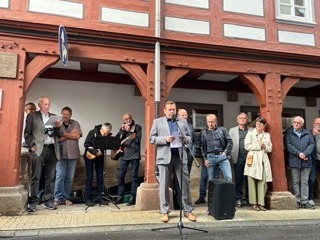
In our case, my grandpa and his family were able to flee and develop a livelihood in the United States and have families. My grandpa had 3 daughters and his sister had 3 sons. Each had kids and that’s how we got to 30 people at this ceremony— nearly everyone from the 3 son/daughter and grandchild generation (that’s my generation) and a few from the great-grandchild generation, too. However, many of these ceremonies have no family present as they are honoring people who were murdered by the Nazis and therefore have no descendants. In fact, there were 4 ceremonies in my Grandpa’s tiny hometown in the mountains that day and the other three were all for people who were killed by the Nazis.
At our particular ceremony attendees included the mayor, a journalist, town historians who have shared pieces of our family’s story we didn’t even know, musical guests, and local school children who researched and told the stories (albeit in German) of all the people who were being commemorated in Spangenberg on Sept 9, 2022.
Which brings me to my next topic: hospitality.
Willkommen
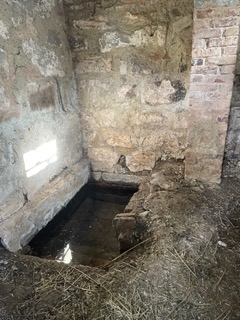
We were incredibly touched by the warm welcome and the various experiences our hosts organized for us. They spent a day and a half with us, giving us tours and helping us connect with the history and the stories of our family in the tiny town of Spangenberg. There are no Jews left in Spangenberg and the Jewish monuments are quite dilapidated at this point. However, we went to the Jewish cemetery where my great, great grandfather is buried. We visited the Mikva which is filled with dirty, stagnant water now, and we walked by the building that used to be the synagogue, but is now a private home. It was hard to tell from the front that it was ever a synagogue, and as we stood there trying to picture what it may have looked like, a neighbor of the synagogue invited all 30 of us to walk through his home and into his back yard where we could get a better view of some of the original design on the synagogue. He had read about our visit in the local paper.


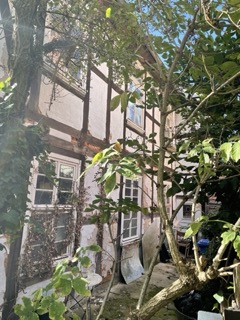

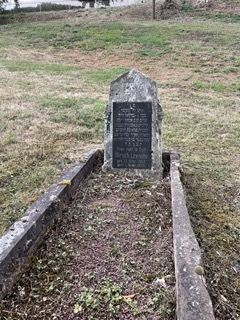

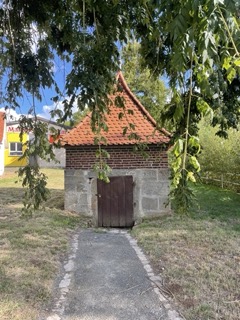



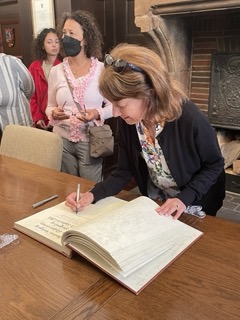
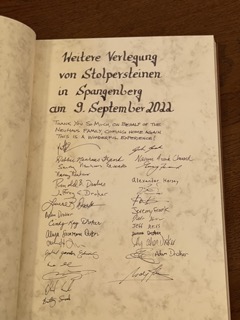
The mayor was present with us much of the day and also hosted us for a lunch and then later for Kaffee und Kuchen (coffee and cake— an afternoon German tradition) with homemade cakes baked by the locals for the occasion. And then they brought us to sign the town’s Golden book which is reserved for signatures of official visitors.




Then there were our hosts. Dr. Dieter Vaupel, an educator, researcher, and historian was the organizer who made this all happen. He reached out to our family (actually to my grandpa, but he had recently passed away in 2018) as he was piecing together the Jewish history of Spangenberg. He shared his research which revealed to us parts of our family story none of us knew. Specifically, we learned that the persecution and livelihood of my grandpa’s family started long before we knew. They fled to the United States in 1937, but the suffering started as far back as 1933 when massive boycotts of Jewish businesses began. By 1935 the business had come to a complete standstill. We also learned of a nocturnal raid of my grandpa’s home in September of 1935— an event he never shared with us. Did he not know? Was he sleeping and his parents never told him or his sister? Or was this a detail he spared sharing with us, as a parent might do to not bring additional sadness or angst to their loved ones?

Dieter was also joined by the town historian, Reiner Pluss, who coincidentally is married to a woman whose grandma worked for my family and he still had the milk and sugar coffee service dishes my great-grandparents had gifted to her for her wedding. He gifted them back to us and they have now come full circle.

Coincidentally, our family had also brought an item full circle back to Spangenberg. The first two floors of my grandpa's home were the family business, a department store called Kaufhaus Levisohn (Levisohn being his mother's family name). In the US my family eventually opened a clothing store on Fillmore Street in San Francisco. We still have a few hangers that hung in the Spangenberg store and then hung in San Francisco for 85 years. My mom brought a few hangers back to their town of origin and where they will remain in the town museum as an artifact from our family business.
Stones and Walls

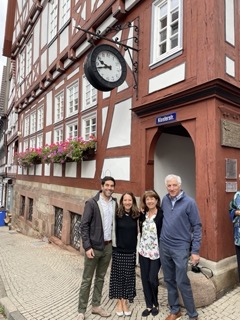


Being outside of my grandpa’s home, which I’d only seen in pictures, was quite moving in and of itself. Walking along the cobblestones he walked on as a kid, in a place that was his livelihood long before any of us knew him, helped me feel connected to him after almost 4 years without him. At the same time, it opened up so many more questions.
A sidenote about the cobblestones: During the Stolpersteine ceremony a public works person is there to remove small cobblestones and replace them with the Stolpersteine. It is tradition in the Jewish religion to place a stone on a grave when you visit it. Upon our return our families will be placing the removed cobblestones from in front of the house on the graves of my grandpa and his sister so they are back with a piece from their hometown.
What was even more moving than being outside the home was going INTO his childhood home. The current owners opened it up to us. It is actually now a “museum” of sorts where the current owners—a hunting family—display their “trophies.” While it was hard to look past the dozens of stuffed fowl, deer, and taxidermy on the main floor, it took my breath away to go upstairs and see a kitchen, bathroom, and rooms that looked like bedrooms, living rooms, and dens. The emotion of being in the same walls he lived in as a boy, looking out windows with the same views he used to see, really sunk in.
What Would My Grandpa Think?
Before, during, and after the trip a constant wonder for me was: what would my grandpa have thought of all this? As a man of extreme practicality I surmise he would not have encouraged us all to travel nearly 6,000 miles to his humble hometown. At the same time, as a social being who thrived on connecting with others, I think he would have appreciated the ceremony, the community-wide involvement, and the hospitality. How would he feel about visiting his hometown today? Would he be struck by familiarity or how much it has changed? How was my city-dwelling, world-traveling grandpa who had season tickets to the 49ers once a country boy from a tiny mountain town? I also know, that even if he were here today, answers to my questions would still not be a guarantee—he was not exactly forthcoming when it came to talk related to emotions. I will continue to sit with these questions, feel grateful for what I was able to glimpse and learn of his past, find comfort in all the ways people who knew and didn’t know him keep his story alive, and study and remember the unfathomable quantity of stories of the atrocities that happened to real people, just like my family, during the Holocaust.
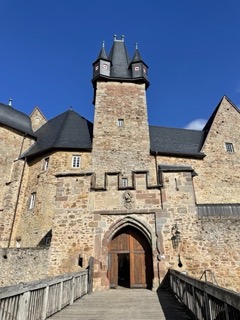
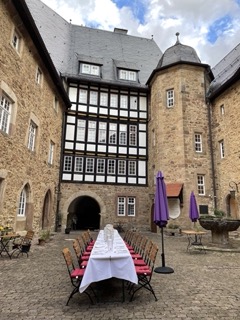
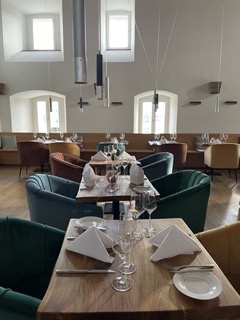
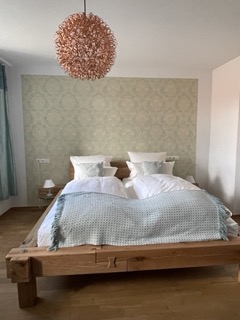
A few more pictures... we stayed in the town's castle: Schloss Spangenberg which was recently turned into a hotel.








Comments